Your cart is empty.

Shop now and pay later
Free Shipping
All over the US
Easy Returns
30 Day Policy
Need Help?
+1 (217) 996-1730
MON - FRI: 9:00AM - 5:30PM (EST)
SAT: 9:00AM - 3:00PM (EST)
-
Account
Account
Table of contents

Decoding Tire Sidewall Markings: A Comprehensive Guide to Reading Tire Sidewalls
How to Read Tire Sidewall Markings in 2026: Complete Guide to Tire Size, Load Index & Speed Ratings

Have you ever looked at your tire’s sidewall and wondered what the alphanumeric markings on it mean? The sidewall contains crucial information about the tire size, load capacity, speed rating, and understanding these markings is essential for maintaining and selecting the right tires for your vehicle.
In this comprehensive guide, we will walk you through the process of decoding tire sidewall markings, which will enable you to make informed decisions and ensure optimal performance and safety of your wheels.
Take a look at the side of your tire. See that string of letters and numbers molded into the rubber? Most drivers glance right past them — but those markings are actually telling you something important.
They cover everything from your tire's size and load limits to its speed rating, age, and how it's built to perform. Once you know how to read them, you'll never have to guess whether a replacement tire is the right fit — and you'll have a real edge when it comes to keeping your vehicle safe on the road.
In this guide, we'll break it all down, step by step.
How to read a tire sidewall:
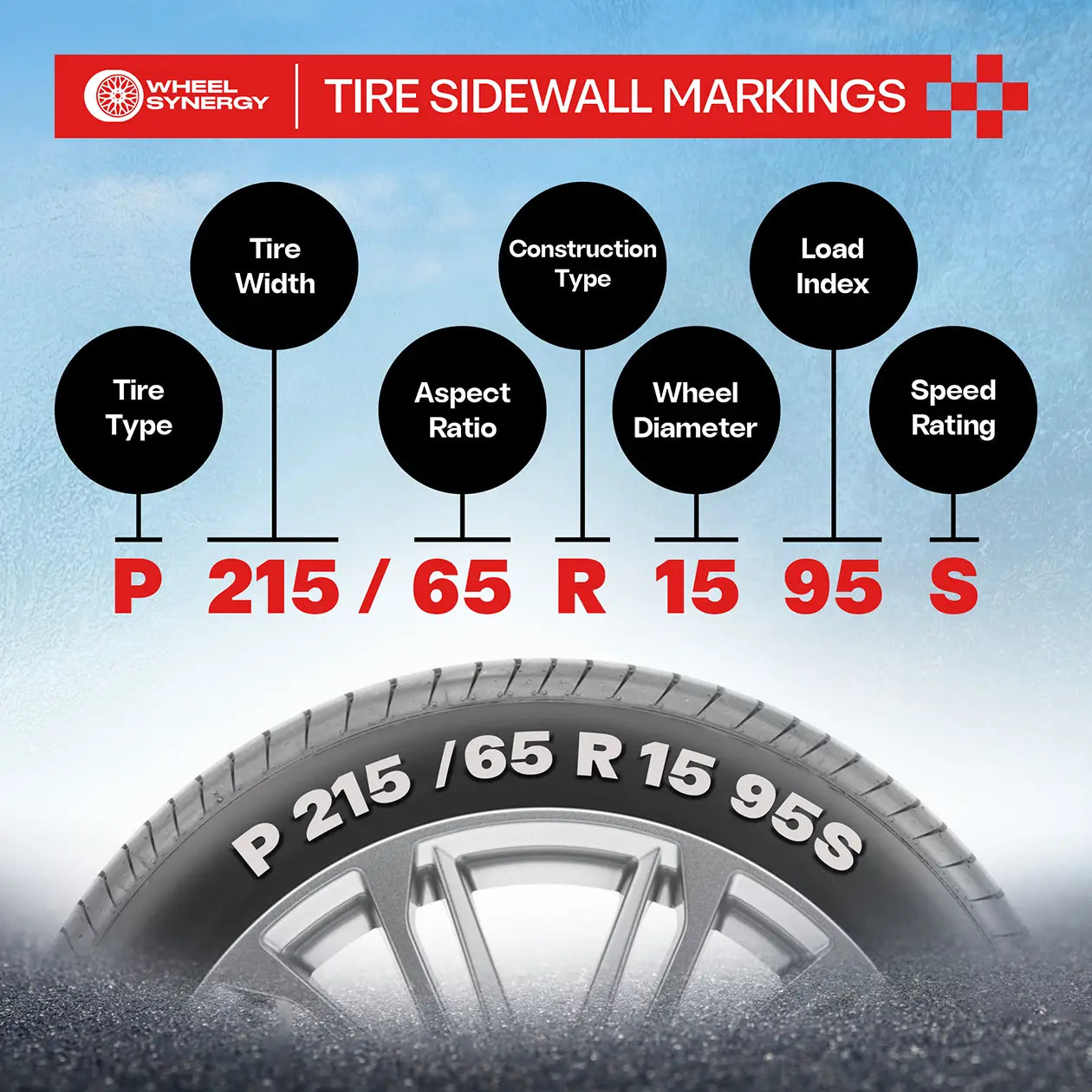
Deciphering tire size:
The tire size is typically the first piece of information you'll encounter on the sidewall. It is expressed in a standardized format like P215/65R15. Here's what each element of the tire size means:
- "P" denotes the tire's application, indicating it is designed for passenger vehicles. Others include "LT" for light truck tires, and "ST" for special trailers.
- "215" represents the tire's width in millimeters, measuring from sidewall to sidewall.
- "65" indicates the aspect ratio or profile, representing the sidewall's height as a percentage of the tire's width.
- "R" signifies the tire's construction type, usually "radial" for the commonly used modern tires.
- "15" denotes the diameter of the wheel in inches that the tire is designed to fit.
 Understanding tire size helps you choose the right replacement tires and maintain proper compatibility with your vehicle.
Load Index and Speed Rating:
Next, you'll find two additional alphanumeric codes representing the tire's load-carrying capacity and speed rating. For example, a code like 95S means:
"95" corresponds to the load index, indicating the maximum load capacity the tire can handle, which in this case is 690 kg.
"S" represents the speed rating, indicating the maximum speed at which the tire can operate safely, which in this case is 180 km/h.

Consult your vehicle's manual to ensure that the load index and speed rating of your tires are suitable for your driving needs.
| Load Index | Kilograms | Load Index | Kilograms | Load Index | Kilograms |
|---|---|---|---|---|---|
| 65 | 290 | 80 | 450 | 95 | 690 |
| 66 | 300 | 81 | 462 | 96 | 710 |
| 67 | 307 | 82 | 475 | 97 | 730 |
| 68 | 315 | 83 | 487 | 98 | 750 |
| 69 | 325 | 84 | 500 | 99 | 775 |
| 70 | 335 | 85 | 515 | 100 | 800 |
| 71 | 345 | 86 | 530 | 101 | 825 |
| 72 | 355 | 87 | 545 | 102 | 850 |
| 73 | 365 | 88 | 560 | 103 | 875 |
| 74 | 375 | 89 | 580 | 104 | 900 |
| 75 | 387 | 90 | 600 | 105 | 925 |
| 76 | 400 | 91 | 615 | 106 | 950 |
| 77 | 412 | 92 | 630 | 107 | 975 |
| 78 | 78 | 93 | 650 | 108 | 1000 |
| 79 | 437 | 94 | 670 |
| Speed Symbol | Approx MPH | Approx KM/H |
|---|---|---|
| Q | 99 | 160 |
| R | 106 | 170 |
| S | 112 | 180 |
| T | 118 | 190 |
| H | 131 | 210 |
| V | 149 | 240 |
| VR | 131 | 210 |
| W | 168 | 270 |
| Y | 186 | 300 |
| ZR | 149 | 240 |
Treadwear, Traction, and Temperature Ratings:
The sidewall often features three important ratings related to treadwear, traction, and temperature resistance. These ratings are denoted by three-letter codes:
-
Treadwear Rating:
- This number indicates the tire's durability and longevity in comparison to a standard reference tire. For example, a tire with a treadwear rating of 300 will wear three times slower than the reference tire.
-
Traction Rating:
- This letter grade represents the tire's ability to grip the road under wet conditions. Ratings range from AA (highest) to C (lowest), indicating the stopping distance on wet surfaces.
-
Temperature Rating:
- Another letter grade, ranging from A (highest) to C (lowest), signifies the tire's resistance to heat buildup and its ability to dissipate heat effectively.

Consider these ratings when selecting tires that align with your driving style and environmental conditions.
Interpreting the DOT Number:
The "DOT" symbol certifies the tire manufacturer's compliance with the U.S. Department of Transportation (DOT) and provides details about the tire’s manufacturing date and location. Displayed as a string of numbers and letters (which looks something like DOTXXXXXXXX1121) is information about when your tire was manufactured. The last four numbers relate to the date of manufacture, so you can identify the age of your tire. In this example, the date code is 1121 which would mean that the tire was manufactured in the 11th week of 2021.
Tire Manufacturer and Model:
The sidewall of the tire often displays the tire manufacturer's name, logo, or brand. Additionally, you may find the tire model or series name, which provides specific details about the tire's design, intended use, or performance characteristics. Recognizing the manufacturer’s information helps you identify the tire's origin and reputation.
Conclusion:
By understanding how to read the sidewall of a tire, you gain valuable insights into your tire’s specifications and capabilities. Decoding the tire size, load capacity, speed rating, treadwear, traction, temperature ratings, and manufacturer information enables you to select the right tires for your vehicle, ensuring optimal performance, safety, and longevity.
Frequently Asked Questions
What do the numbers on a tire sidewall mean?
They indicate the tire's width, aspect ratio, construction type, wheel diameter, load index, and speed rating.
How can I tell how old my tire is?
Check the last four digits of the DOT code. The first two digits indicate the production week, while the last two indicate the production year.
What does the "R" in tire size mean?
The letter "R" stands for radial construction, the most common tire construction used today.
Can I use tires with a different speed rating?
You should follow the vehicle manufacturer's recommendations to ensure proper safety and performance.


